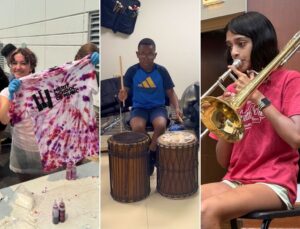
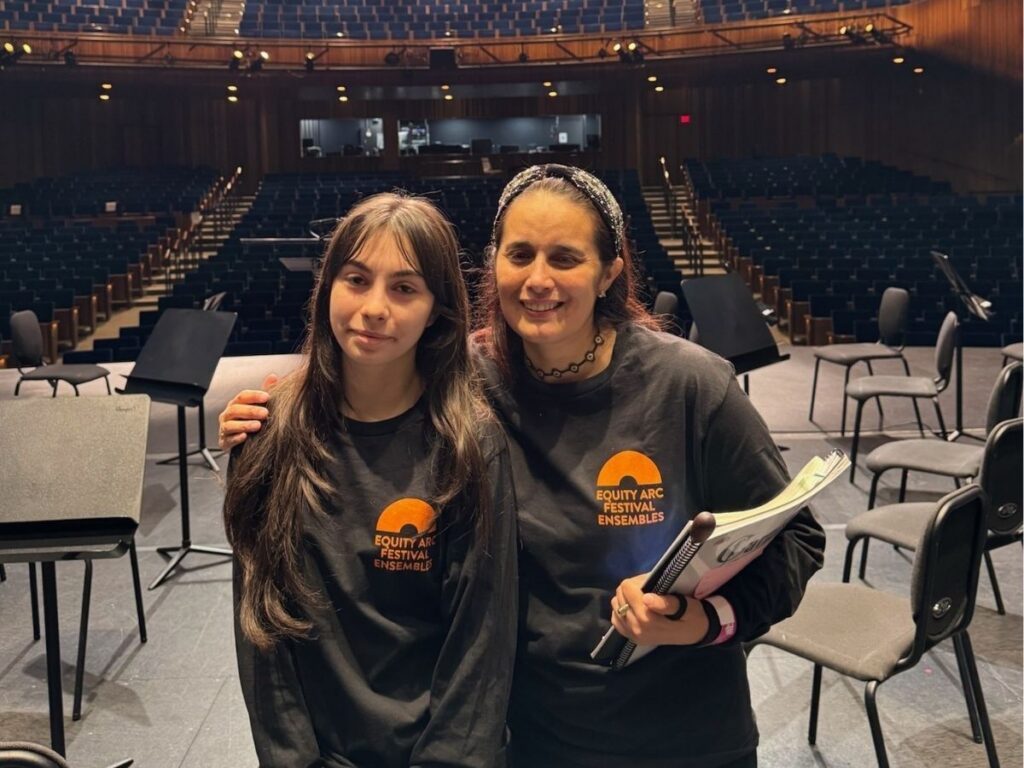
When young musicians gather through Equity Arc, something powerful happens: doors open, horizons widen, and students who come from long underrepresented backgrounds in classical music see themselves reflected in its future. Equity Arc exists to level the playing field, building pathways for young BIPOC musicians whose talent deserves every opportunity to flourish. It’s a mission Merit knows well: our president and executive director, Charlie Grode, also serves as Equity Arc’s board chair, strengthening the bridge between national pathways and the work we do every day in partnership with Chicago Musical Pathways Initiative (CMPI).
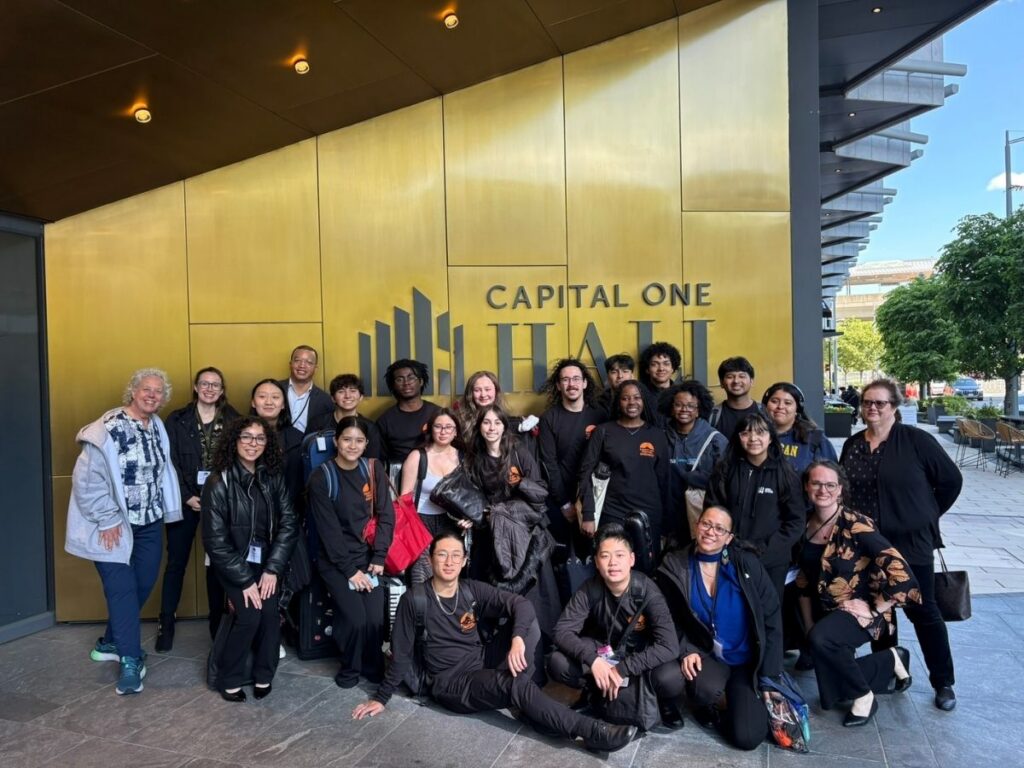
This spring, nine Merit School of Music students (who are also CMPI fellows) traveled to Washington, D.C. for the Equity Arc Convening, where orchestral rehearsals were interspersed with conversations about justice, identity, and the responsibility of artists in a changing world. Under the baton of Lina González‑Granados, in the presence of leaders like Bryan Stevenson, and surrounded by peers from across the country, these young musicians encountered a world of classical music that felt expansive, possible, and profoundly their own.
Among them was 17-year-old violist Olivia Doolin, who arrived with questions about where she fit—in the orchestra, in her mixed cultural heritage, and in a field that has not always reflected the fullness of her identity. Over the course of four days in D.C., she found more than a series of rehearsals and lectures; she found a community that mirrored her complexity, a conductor who embodied the leadership she hoped to grow into, and moments of representation that reshaped how she understood her place in the musical world.
The Space Between the Notes
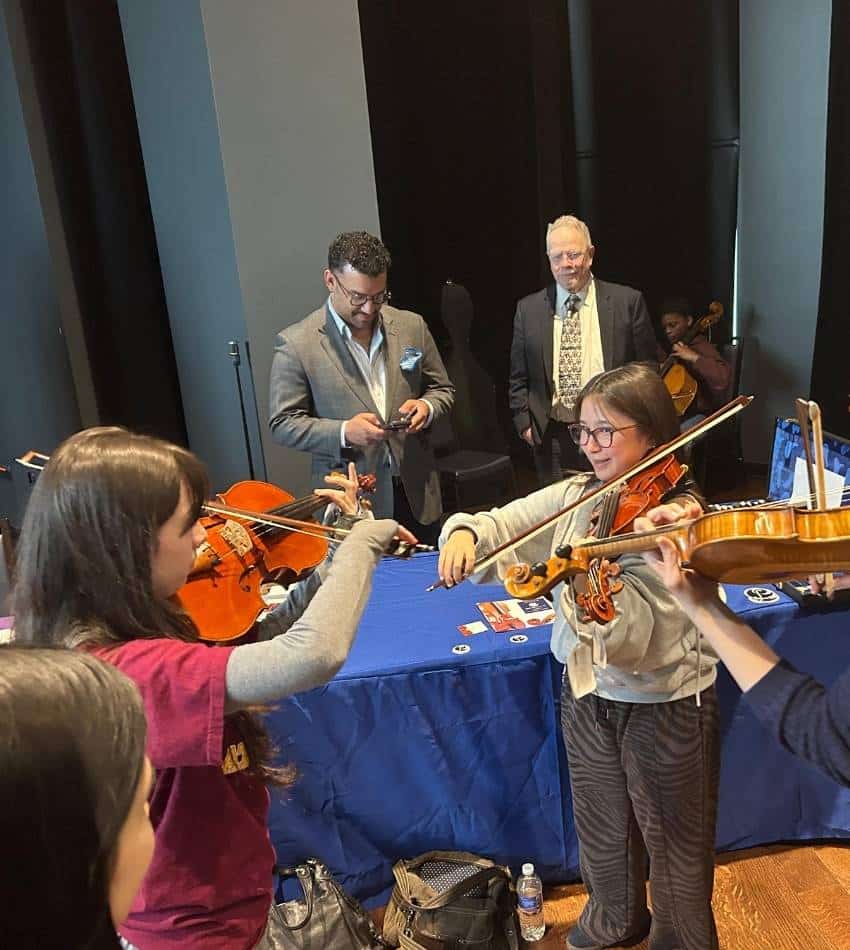
While the schedule was packed with rehearsals, panels, and performances, some of its most transformative moments happened in the in‑between spaces: hotel‑room card games, impromptu sight‑reading sessions, a shared cake from a Trader Joe’s run, and conversations that stretched past curfew. Students from across the country found themselves building a community that felt both new and deeply familiar.
“We were all waking up at the same time, rehearsing until 10 p.m., eating together,” Olivia said. “How could we not get close?”
Beyond the demands of the rigorous schedule, Olivia actively pursued making connections outside of her comfort zone. At last year’s Equity Arc Convening in Chicago, she mostly stuck with her familiar Merit and CMPI friends, branching out a little to make friends with other violists in her section. But this time around, she was determined to change that. “I was on a mission this year to broaden my circle, which I did. I met some amazing people!”
Those connections mattered. They cultivated the trust that allowed students to talk honestly about identity, belonging, and the pressures of pursuing classical music at a high level. They made room for vulnerability and for the kind of reflection that can’t happen on your own in a practice room.
Representation From the Podium
For Olivia, one of the most powerful images of the weekend came from the podium. The Pathways Orchestra was led by Lina González‑Granados, a conductor whose presence carried both artistic authority and personal resonance.
“I haven’t really seen many female conductors,” Olivia says, “so it was amazing getting to be under her baton this year. Especially because she’s also Latina—just like me!”
The repertoire—Jessie Montgomery’s Hymn for Everyone, Dvořák’s Carnival Overture, and Tchaikovsky’s Romeo and Juliet Overture—was familiar to her. But under González‑Granados, it felt transformed. Tempos shifted, bowings changed, and the emotional landscape of each piece opened in new ways.
The musical lesson was inseparable from the symbolic one: leadership in classical music could look like her, sound like her, and carry the same cultural complexity she carried.
Reframing Identity
If the podium offered one kind of representation, the keynote offered another. Bryan Stevenson’s address—unfiltered, urgent, and deeply human—left the room in stunned silence. He spoke about inequity in orchestral representation within the broader context of America’s racial history, underscoring why initiatives like Equity Arc are essential.
Olivia described it as “the most emotionally impactful speech” she had ever heard, and his words prompted her to revisit questions she had carried for years around her own identity as a young musician of Mexican, Swedish, and Irish descent. “When I was at Equity Arc last year, I questioned, where do I really fit in here? Appearance‑wise, I don’t present 100% as somebody who looks Latina. My last name is Irish, and I always wondered if people thought of me differently because I was mixed and I didn’t really look like a lot of my Latina peers.”
This year, surrounded by peers whose identities were as varied as their instruments, she began to see her heritage as a source of wholeness rather than a complication. Listening to Stevenson caused her to reflect on the diversity within the Latino community itself—how “we all look so different,” and how that variety “helps us come together as a community, instead of drive us apart.”
What emerged was a new sense of self‑acceptance: “Being mixed doesn’t divide me into halves—it makes me perfectly whole.”
Claiming a Place in the Future of Classical Music
The Pathways Orchestra performed immediately after Stevenson’s keynote—a “powerhouse move,” according to Olivia, because the message fueled the musicians’ determination to give everything they had.

It also inspired deep gratitude. “I thought a lot about the communities that helped me get to where I am today. I am definitely a product of Merit; I’ve been there since I was seven. But I thought a lot about how Merit connected me with CMPI, too. I had people on both sides supporting me.”
By the time the final notes faded, something had settled inside her. The weekend had offered her a conductor who reflected her, a keynote that challenged her, and a community that embraced her. It gave her a new understanding of belonging, not by fitting into a narrow mold, but by bringing her full self into the room.
Her words capture the shift: “If you want to know what a Latina looks like, I am exactly what a Latina looks like.”
That declaration is not just personal. It is a testament to what becomes possible when pathways are intentional, when representation is real, and when young musicians are given the space to see themselves, fully and without compromise, in the future of classical music.