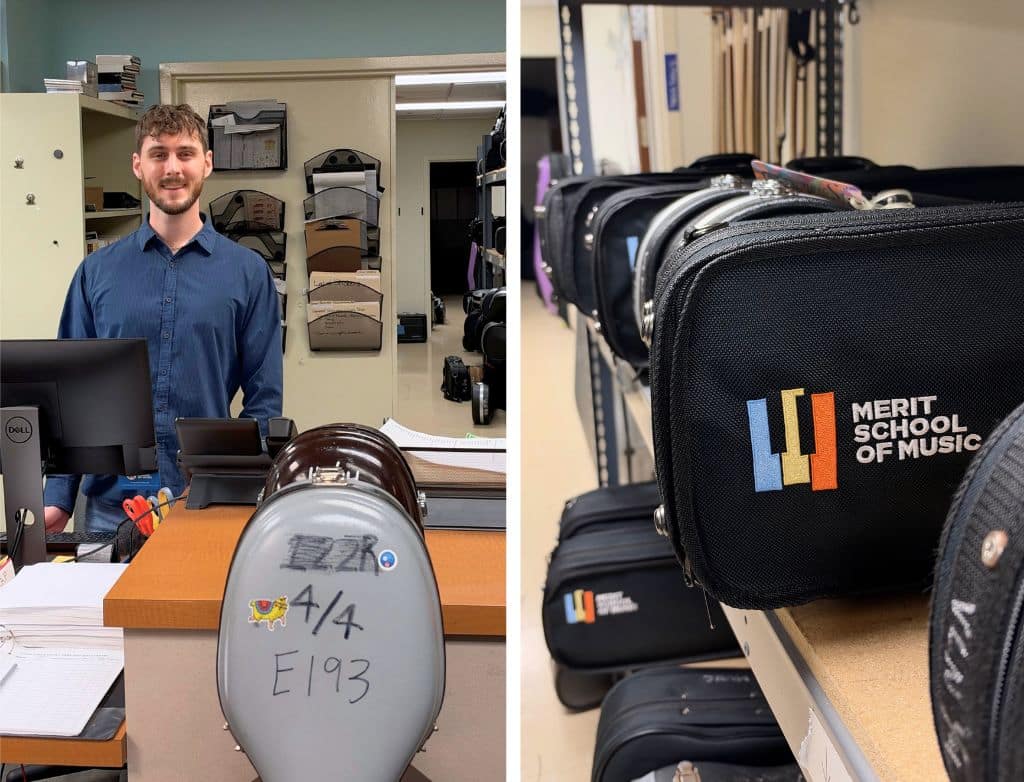
As you make your way through the halls of Merit School of Music, the corridors are filled with the overlapping sounds of practiced scales, unfinished melodies, and the buzz of students rushing to class. But across from Gottlieb Hall, tucked away from the daily commotion, is a space that plays a quieter but no less essential role in making all that music possible: Merit’s instrument library.
The instrument library has long been part of Merit’s effort to make music education accessible to students, regardless of their family’s financial circumstances. We recently sat down to chat with instrument librarian Todd Humphrey, who oversees a collection of more than 1,600 instruments, from piccolos to string basses.
Renting an Instrument
For as little as $10- $25 a month, Merit families can rent an instrument for their child’s musical education. It’s a relatively modest fee for access to something that can otherwise be prohibitively expensive: a new student violin, for instance, can cost around $1,000, an upfront investment that might be enough to keep a child from ever picking one up in the first place.
There’s also the practical matter of growing up. A violinist may start out on a 1/16 size violin at age four and cycle through five or more instrument sizes before they grow into a full-size violin as a teenager. Purchasing new instruments at such a rate would be unsustainable, so having the flexibility to simply trade it in for the next size up is incredibly important.
“A student will outgrow an instrument and move up to the next size, discover that another one suits them better, or simply decide that the instrument they initially gravitated toward isn’t quite the right fit,” Todd shares. “The library makes room for that uncertainty, rather than asking families to commit hundreds or even thousands of dollars before a child has had the chance to find their footing. It allows young musicians the freedom to experiment, change course, and discover what they love.”
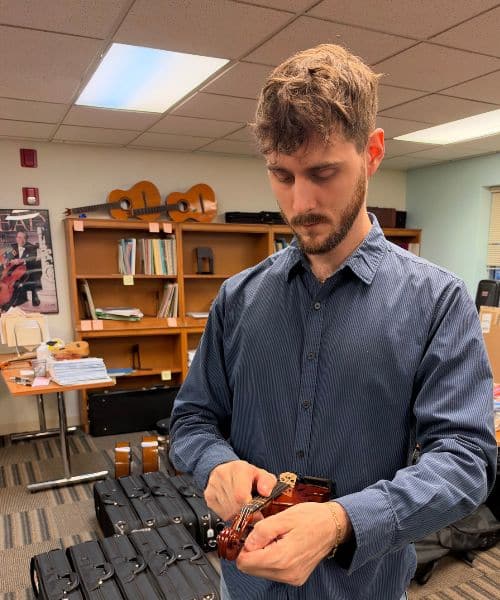
As a cellist himself, Todd understands the difference that using a quality instrument can make in a student’s development. “Having a nicer instrument allows you to give yourself more room to push your skills further,” he explains. “Nicer instruments are more responsive to the student’s playing.”
Instrument Care and Upkeep
Learning to play an instrument also means learning how to care for one. For many students, a borrowed instrument is their first experience being responsible for something of significant value.
“It’s so easy to damage instruments if you’re not being mindful of how you treat them,” Todd says. “Our students learn how to care for these borrowed and delicate instruments, and it changes how they treat and relate to material objects.”
Along the way, students learn habits that help protect the instruments for future generations of Merit musicians. Of course, accidents happen, and Todd coordinates repairs and maintenance whenever they’re needed.
Beyond the Instruments
The library’s role doesn’t end once a student has an instrument in hand. Beyond instruments, it also provides many of the supplies students need throughout the year. From rosin and rock stops to cleaning cloths and valve oil, the library helps remove small but important obstacles that can interrupt a student’s progress. If a violinist in Merit Philharmonic breaks an E string during rehearsal or an oboist in Wind Symphony discovers they need a new reed, help is just a short walk down the hall.
Free Sheet Music Available!
As Merit prepares for this summer’s renovation, we’re giving away a large selection of sheet music to students and families. Stop by the instrument library to browse the collection and take home something new to play!
Bringing Instruments to the Communities Across Chicago
The impact of Merit’s instrument library extends far beyond the walls of the Joy Faith Knapp Music Center. Todd also coordinates the distribution and maintenance of hundreds of instruments used in schools across Chicago through our Merit Music in Communities (MMiC) program.
For many students in these partner schools, those instruments provide an opportunity to participate in music education that might not otherwise be available. Whether an instrument is checked out by a student in the West Loop or delivered to a classroom on the South or West Side, the goal remains the same: ensuring that young people have access to quality instruments and the opportunities that come with them.
A Legacy of Access
Providing students with access to affordable, high-quality instruments has been a priority since Merit was founded in 1979. Early support came through instrument drives and donations from organizations such as the Musical Instrument Bank, and community support continues to sustain the library today. Many of the instruments in the collection have been donated by former musicians, families, and community members looking to give them a second life in the hands of a young player.
Interested in donating an instrument to Merit? →
Sometimes the impact of that generosity becomes especially clear. Todd recalls one young student who eagerly anticipated moving up to the next size cello as they grew. The instrument was ready, but the appropriate case had to be ordered. The student counted down the days until it arrived.
Moments like these remind Todd that an instrument is never just an object. For many students, it becomes an important part of their musical growth, opening new possibilities as their skills and confidence develop.
In a building devoted to the sounds of young musicians finding their voices, the instrument library offers a reminder that access to music education begins long before the first note. Sometimes, it starts with something as simple as having an instrument to call your own, even if only for a little while.
And the library is worth a visit, even if you’re not in need of an instrument! Todd encourages students and families to stop by, explore the collection, and learn a little more about what’s housed behind its doors. With more than 1,600 instruments, there’s plenty to see—and Todd is always happy to share a bit about the instruments and the stories behind them.